
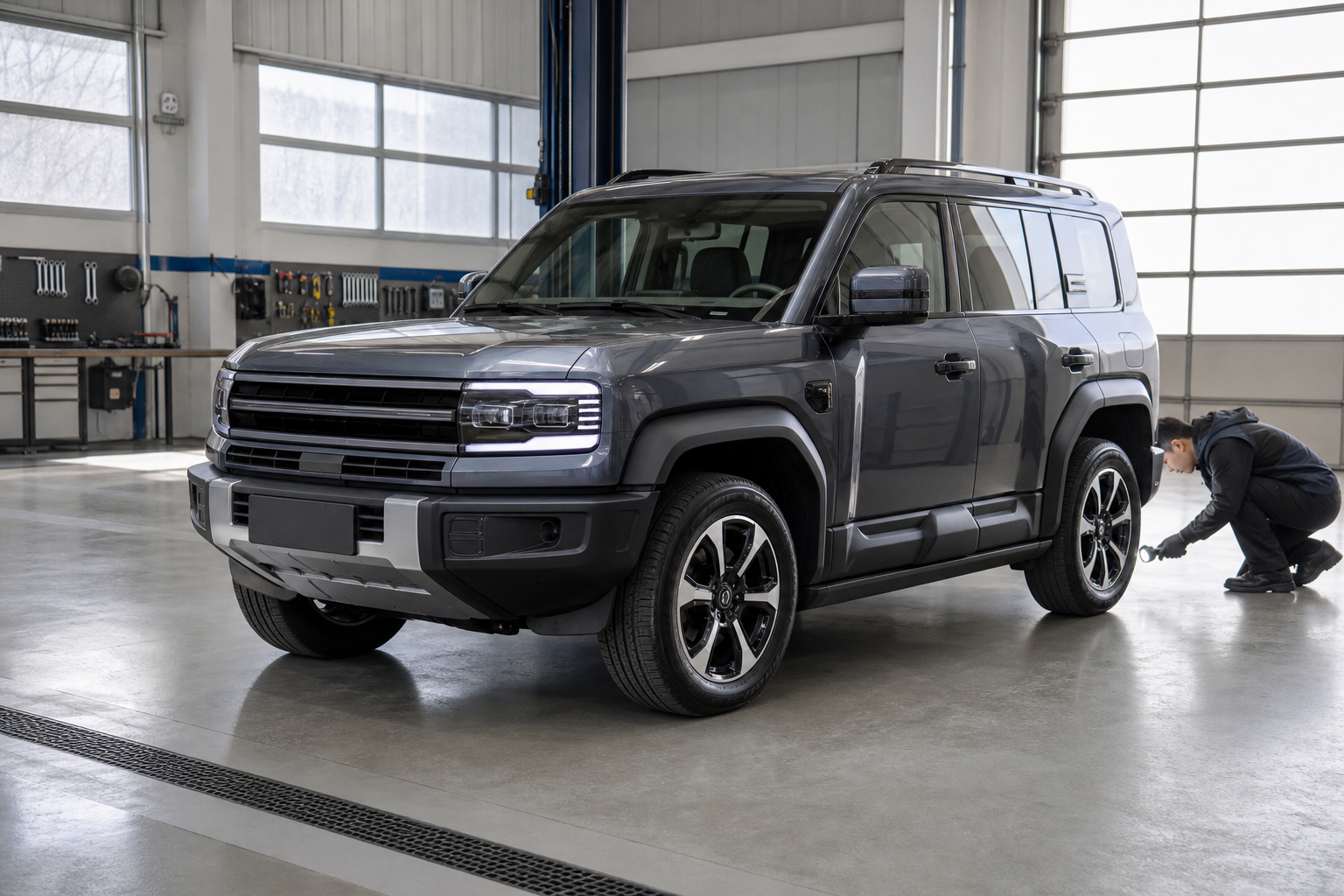
The decision on verify bao 5 disus-p and hydraulic suspension hardware stays attached to one selected VIN. Record identify the installed suspension, inspect hydraulic components and run a controlled function test before comparing routes; keep connect tyres and alignment, map destination service support and price uncertainty explicitly visible through quotation and handover.
Continue the evidence route: Start by decoding the candidate in the Bao 5 version guide, relate suspension hardware to the intended terrain assessment, and carry measured defects into the overseas service plan.
Identify the installed suspension
Match VIN, production date, official version record, control menus, underbody hardware and diagnostic identity. Do not describe every Bao 5 as DiSus-P equipped, and do not treat DiSus-P, DiSus-P Ultra and a standard suspension as interchangeable names.
Evidence threshold. For identify the installed suspension, Record the exact version, hardware photographs and diagnostic system name. Link identify the installed suspension to the VIN and source date. Name who checked identify the installed suspension, and retain enough detail for another reviewer to reproduce the result.
Inspect hydraulic components
Look for leakage, damaged lines, contaminated fittings, impact marks, uneven ride height and prior replacement. Inspect arms, bushings, joints, dampers, mountings and adjacent underbody structure instead of judging the system from a dashboard screen alone.
Failure condition. For inspect hydraulic components, Photograph every corner at a consistent ride-height setting. If inspect hydraulic components stays open, specify whether to reject, reprice or reinspect. Do not treat seller silence about inspect hydraulic components as supporting evidence.
Run a controlled function test
Test available height, stiffness or body-control functions on level ground under the correct operating conditions. Record warning messages, response time, noise, final height and functions that could not be activated; a short video without conditions is incomplete evidence.
Destination effect. Save before-and-after measurements beside the test conditions. Ask the destination adviser whether run a controlled function test changes customs or registration. Check charging, road use and service separately when run a controlled function test affects them, then retain the dated response.
Connect tyres and alignment
Incorrect wheel size, tyre pressure, alignment or suspension wear can distort ride and system behaviour. Check all four corners together and investigate repeated correction, steering offset or unusual tyre wear before approving a simple alignment remedy.
Cost effect. Link the suspension result to the wheel and tyre inspection. Price connect tyres and alignment as its own inspection or preparation line. If connect tyres and alignment creates compliance risk, show the contingency clearly rather than burying it in a general discount.
Map destination service support
Confirm who can diagnose, calibrate, fill, repair and source the fitted system abroad. General BYD experience does not automatically provide model-specific hydraulic tools, software access or correct part numbers for a China-market Bao 5.
Custody check. Name a credible workshop and parts route before shipment. Reconfirm map destination service support at each custody transfer. Seller, inspector, transporter and port records for map destination service support should remain dated and tied to the same VIN.
Price uncertainty explicitly
Separate confirmed wear, preventive preparation and unresolved hydraulic or electronic faults. A warning that cannot be reproduced still belongs in the file; do not bury potential suspension work inside a general vehicle discount.
Replacement rule. Assign pass, hold or specialist diagnosis to each open item. A substitute must repeat every check for price uncertainty explicitly. Similar colour, mileage or trim cannot transfer the previous VIN’s conclusion about price uncertainty explicitly to another vehicle.
Create a four-corner baseline
Measure wheel-centre-to-arch height on level ground with tyre pressures, load, selected mode and state of charge recorded. Photograph component routing and ground clearance from repeatable positions. This baseline helps distinguish a control setting from sag, leakage, impact damage or a mismatched replacement part.
Test road behaviour separately from height change
A successful raise or lower command does not prove damping, steering or body control is healthy. On a safe route, record pull, oscillation, harshness, clunks, steering return and warning behaviour at appropriate speeds. State the route and access limits rather than claiming a complete dynamic diagnosis.
Check accessory interference
Aftermarket protection, steps, wheels, lift-related parts or recovery equipment can alter clearance, mass, sensor references and service access. Record modification manufacturer, installation points and document trail. Return-to-standard costs should be separate from repairs to original suspension hardware.
Prepare the arrival workshop
The handover should include version identity, suspension type, diagnostic baseline, ride-height measurements, fault history, accepted repairs and unresolved tests. If the receiving workshop cannot support the system, price transport to a capable facility before the vehicle leaves China.
Primary model and market references
Official sources describe their own publication date and market. Confirm the selected VIN before applying a figure.
Close the file without hiding open items.
Close “Verify Bao 5 DiSus-P and Hydraulic Suspension Hardware” with the candidate VIN, source date and the evidence used for identify the installed suspension and inspect hydraulic components. Name rejected alternatives and unresolved questions, then assign responsibility for map destination service support and price uncertainty explicitly. A changed vehicle or destination reopens the affected checks.
- Identify the installed suspension: confirmed / open / not applicable
- Inspect hydraulic components: confirmed / open / not applicable
- Run a controlled function test: confirmed / open / not applicable
- Connect tyres and alignment: confirmed / open / not applicable
- Map destination service support: confirmed / open / not applicable
- Price uncertainty explicitly: confirmed / open / not applicable
Three questions before commitment
What closes “Identify the installed suspension”?
Record the exact version, hardware photographs and diagnostic system name. For identify the installed suspension, attach a dated source and candidate identifier, then name who produced or verified the record. A listing label is not enough to close this checkpoint.
What closes “Inspect hydraulic components”?
Photograph every corner at a consistent ride-height setting. Mark inspect hydraulic components as confirmed only when the supporting record matches the VIN and route assumptions. Otherwise show the item as open in the quotation or inspection scope.
What closes “Run a controlled function test”?
Save before-and-after measurements beside the test conditions. If records about run a controlled function test conflict, preserve both sources and ask the responsible party to resolve the difference before deposit, preparation or shipping instructions.